Intervene
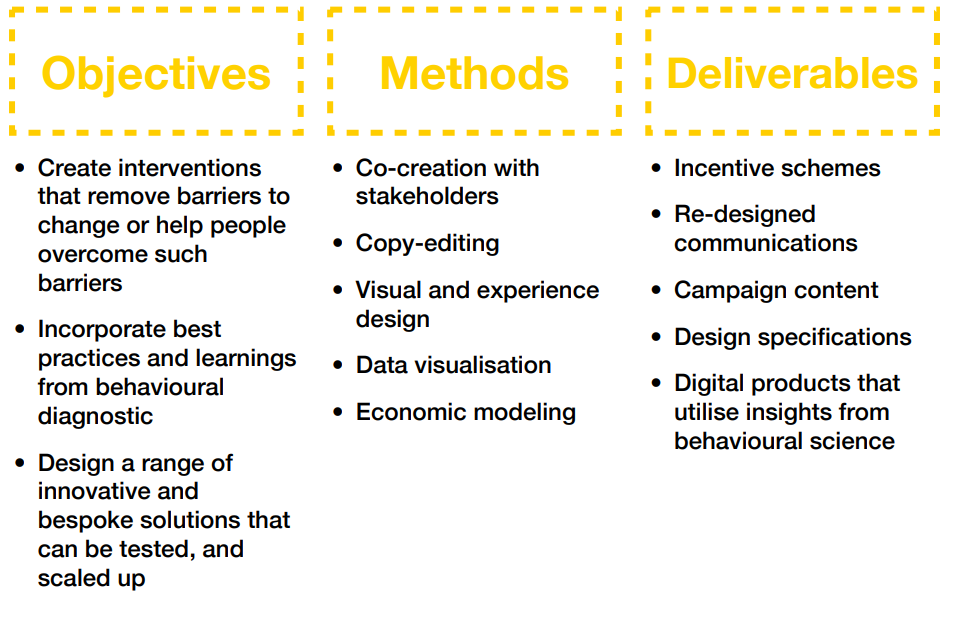
Following the behavioural diagnosis, we proceed to design behavioural interventions to encourage the adoption of the target behaviours. The interventions are often based on insights from behavioural science that have been shown to be effective in helping to overcome the barriers identified in the previous phase.
During this process, we engage with easy-to-understand behavioural science principles and rules of thumb, such as those detailed in MINDSPACE, Friction and Fuel, and EAST.
| Behavioural Frameworks for Workshops and Intervention Design | |
| Mindspace | MINDSPACE was developed in 2010 by The Institute for Government and resulted in the creation of the BIT. It focuses on nine forces that drive behaviours across a variety of contexts – Messenger, Incentives, Norms, Defaults, Salience, Priming, Affect, Commitments, and Ego. The framework was originally conceived to fuse behavioural science and public policy (e.g., design policies that nudge citizens towards making better decisions). |
| Friction and Fuel | The ‘Frictions and fuels’ model was developed by the Center for Advanced Hindsight and Pattern Health. It focuses on frictions (barriers) and fuels (enablers) as the two driving forces in closing the gap between current behaviours and desired behaviours. Friction components include bias, ego, and habits, while fuel components include appeal, visceral, incentives, others, and reminders. Originally developed to promote healthy behaviours, though, it can easily apply to other types of behaviour as well. It is suitable as workshop materials (e.g., introduction to behavioural science workshops) |
| EAST | Developed by the BIT and designed for “busy” policymakers, the EAST framework is a simple, memorable framework to make more effective and efficient policy. If you want to encourage a behaviour, make it Easy, Attractive, Social and Timely (EAST).” There are many examples of use cases by BIT (energy sector, government, charities, etc.) mostly for redesigning forms, electronic portals, letters, comms campaigns and service design. |
Intervention design – potential learnings