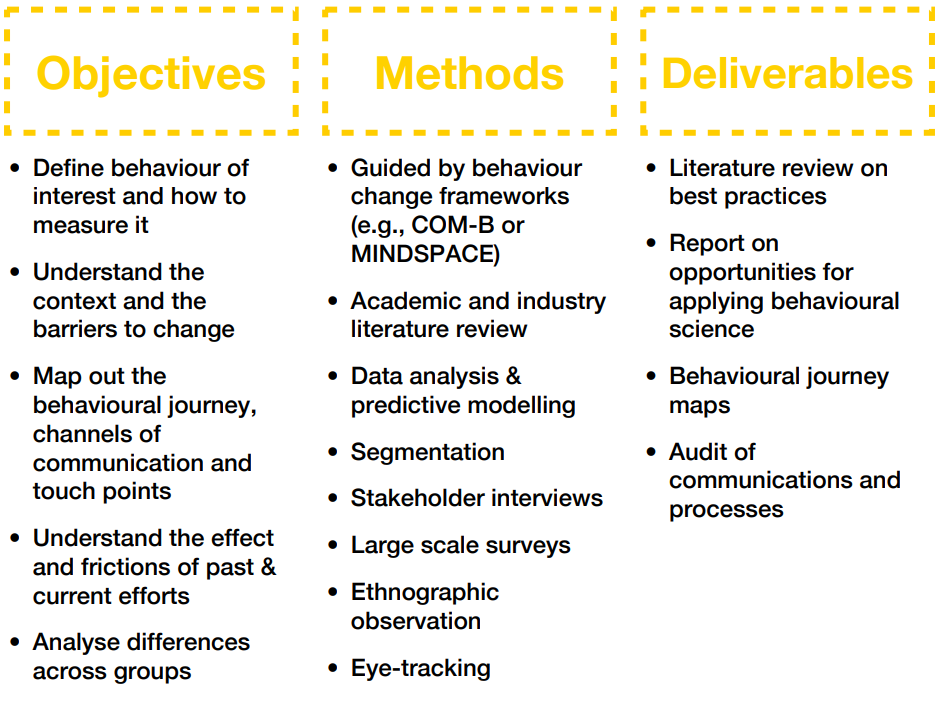
Diagnose Behaviour
Within live projects it is crucial to define the target behaviours, which is usually done by consulting with the client and other stakeholders, conducting stakeholder workshops and interviews, as well as by reviewing relevant evidence. Conducting a behavioural diagnosis, which consists of identifying the drivers, barriers, and facilitators of the target behaviour is the next key step. Within this phase it will be appropriate to draw from established behavioural frameworks such as B=MAT, COM-B, the Transtheoretical Model of Behaviour Change, the Theory of Planned Behaviour, and the Behavioural Drivers Model (BDM) to help identify and classify behavioural barriers and drivers.
Examples
|
Behavioural Frameworks |
Description |
|---|---|
|
B=MAT (developed by BJ Fogg, Stanford Behaviour Design Lab) |
A comprehensive view of behaviour by breaking it down into three key components: Motivation, Ability, and Trigger. Motivation represents the individual’s desire to perform the behaviour, Ability reflects their capability to do so, and Trigger signifies the cues or prompts that initiate the behaviour. 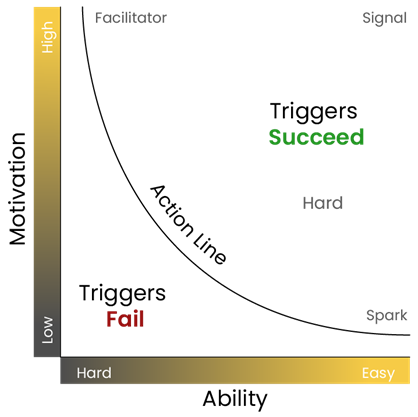 This framework allows us to design interventions that address both motivational and environmental aspects of behaviour and helps us pinpoint the right time(s) to prompt behaviour change. The framework has beenapplied in the past for tech adoption, digital behaviour change (e.g., increasing user engagement), and to promote small-scale habits (e.g., taking vitamins). |
|
The COM-B model (developed by Michie and colleagues, UCL) |
The COM-B model (developed by Michie and colleagues, UCL) provides a systematic approach to understanding behaviour by examining three core components: Capability, Opportunity, and Motivation. Capability refers to the individual’s psychological and physical capacity, Opportunity involves external factors facilitating or hindering behaviour, and Motivation encapsulates the individual’s mental processes influencing behaviour. By dissecting these factors, we gain insights into the individual and environmental determinants of behaviour. This framework, therefore, guides our analysis, enabling us to tailor interventions that address specific deficits in capability, opportunity, or motivation related to the target behaviour. 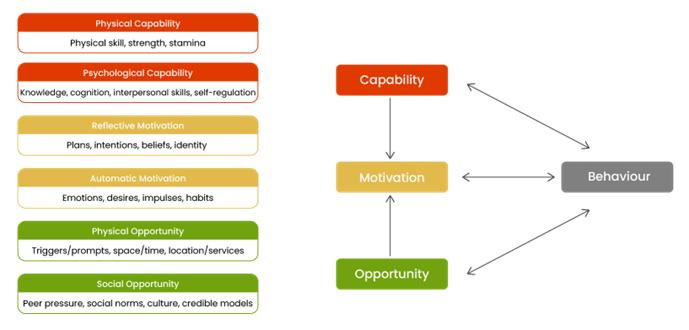 |
Behavioural Diagnostic – potential learnings